


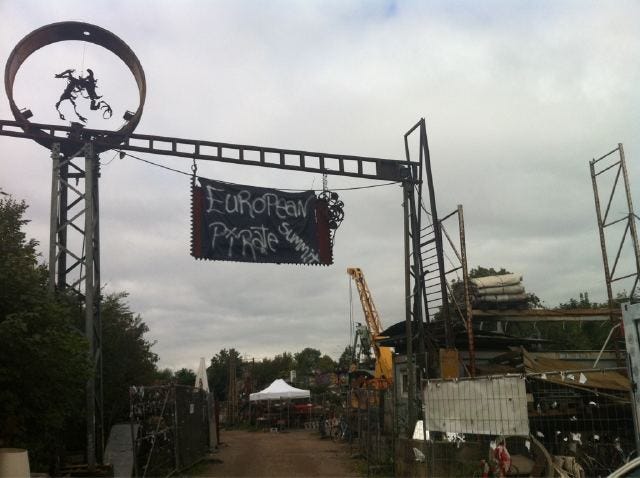
When we started PIRATE Summit in 2011, the idea was simple enough. Bring a few hundred founders to Cologne. Celebrate the thing we were all doing. We weren’t fans of the tech conferences that existed at the time, so we built something we’d actually want to show up to.
That spirit hasn’t changed. But what we learned along the way changed us.
The Road Trip That Changed Everything
In 2012, a few of us packed into a car and drove through Eastern Europe. We organized small events in 6 countries. Skopje. Prishtina. Stops that sound exotic on conference circuits but feel entirely different when you’re actually there, meeting the people at 2am in a bar, hearing their stories.
What started as a road trip grew into something bigger. Over the next few years, we organized 50+ events in 40+ countries. We called it PIRATEs on Shore, then PIRATE Summit Global.
We went to cities like Baku, Minsk, Poznan, Tbilisi, Tehran. Places that don’t show up on the lists of “top startup ecosystems” but that blew our minds with what we found there.
What we found were people with ideas that could genuinely change their markets. Hungry, serious, working with far less than their counterparts in Berlin or London - and somehow moving faster.
The gap was visibility. These ecosystems were hard to access from the outside - they didn’t have the exposure, the investor networks, or the recognition they deserved. The entrepreneurs there had the skills and the motivation. What many of them lacked was access to the broader world of resources, mentors, and connections that founders in Berlin or London take for granted.
The Scale Problem
Passion doesn’t scale. We figured that out the hard way.
Throughout our travels, our conviction that we were working on the right topic kept growing. But the execution was brutal. At one point, 3 people were working day and night for 6 months to plan events on 3 continents. Once the first event started, the next one was already coming and we had to immediately shift focus.
One event would start and the next was already due. We were always slightly behind, and it showed. The quality was often not up to our standards, and we could rarely unlock the full potential of these local ecosystems with our own events.
We had to be honest with ourselves. Is this actually working?
Over 5 years, the relationships we built were real. Personally, without question. But we kept coming back to the harder question: was it actually moving the needle for the ecosystems themselves? We knew we could do better. The model we used wasn’t scalable, and it wasn’t efficient.
We had to reimagine it. (Unlearning in action, years before we gave it a name.)
Why We Acquired Startup SAFARI
In early 2017, we started talking with Maciek Laskus, who had built something we hadn’t seen before: a decentralized multi-day event format where local startups literally open their doors to the public.
No big stage, no keynotes. You travel through a city and visit startups in their offices. It’s authentic, it scales locally, and it connects the ecosystem from the ground up.
The more we looked at it, the more we realized it could be the vehicle for what we’d been trying to build all along: a decentralized global network of startup ecosystems.
So we acquired it.
It fit. PIRATE Summit was built for bringing international founders into one room. Startup SAFARI was built for making local ecosystems legible to the outside world. Together, we could do both.
The Fortune Five Million
There’s a belief in the startup world I’ve been pushing back on for years: the only companies worth paying attention to are the ones swinging for massive scale. Unicorns. Billion-dollar valuations. “The next Facebook.” The Fortune 500 of the startup world.
I find a different group of companies much more interesting. I think of them as the Fortune Five Million.
These are the companies that don’t get press coverage. They’re not raising Series C rounds. They’re not on magazine covers. But they create jobs. They serve their customers. They contribute to their communities. They’re often profitable. And they give their founders lives they chose on purpose.
A woman in Tbilisi building a logistics startup that solves a problem specific to the Caucasus region. A team in Prishtina building developer tools. A guy in Lagos automating something that nobody in San Francisco has even thought about.
These are the entrepreneurs that fascinate me. They’re carrying the same weight as any founder in Berlin or New York - and doing it with far less infrastructure around them. They deserve recognition. They deserve access. They deserve the same quality of ecosystem support.
A thriving, messy, sprawling ecosystem beats a monoculture of a few giants. We’ll take the long tail.
That’s the market we chose. That’s where we want to be.
What We Learned
Looking back, a few things stand out.
The best ecosystems aren’t built top-down. They’re built by the people who show up - the meetup organizers, the co-working space founders, the early investors writing small checks because they believe in a person, not a market. These people are the infrastructure. And they’re dramatically under-appreciated.
You also can’t export culture. Every ecosystem has its own character - shaped by the local problems, the local pride, the local chaos. Trying to make Prishtina look like Berlin doesn’t work. It shouldn’t. The diversity is the point.
And then there’s the letting go. The road trip through Eastern Europe was magic. But magic doesn’t scale - what scales is a model that empowers local people to build their own version of it. That’s what Startup SAFARI did. And letting go of doing it ourselves was one of the harder decisions we made - and one of the better ones.
For more on the philosophy behind PIRATE Summit and the companies we tried to celebrate, read You Can - But You Don’t Have To and Solve Real Problems.
🙏
Be kind,
Manuel