


I spend about 90% of my working time in front of an AI interface.
I’m still blown away by what it can do. I also keep thinking about the consequences, for society, for businesses and for individuals.
Software is where AI is most advanced. That’s also where the biggest lever is.
More software is coming
When software gets cheaper to build, people try more ideas. Problems that never justified a custom tool suddenly do (a 10-person team can finally afford the internal app it used to dream about). We build an entire management tool just for one of our events (OMClub). It was absolutely worth it.
In my first economics class at university, I learned that when something gets cheaper to use, we often end up using far more of it in total. I think that’s likely true for software. Software will keep eating the world, just faster with AI.
More software doesn’t settle the jobs question
It doesn’t tell us whether there will be more or fewer software jobs. Demand could grow 10x while productivity grows 100x. We’d end up with far more software and fewer people writing it. Both can be true at once.
“Software demand will grow” and “engineering jobs are safe” are different claims. I’m wary of sliding from one to the other because it feels good.
Right now, at division5, we see companies hiring constantly. Software developers are still in demand. That’s today’s picture. We’ll see whether that will be true in 5 years.
Where the speed goes
The whole picture is more complicated. There are some interesting dynamics at play. In big companies writing code may be just 20% of getting something to a customer. Make it free and the whole process gets 1.25x faster at best, because the other 80% is still there.
That 80% is deciding what to build, reviewing it, getting approval, releasing it and persuading someone to use it. A prototype takes a day now. A customer’s yes still takes weeks.
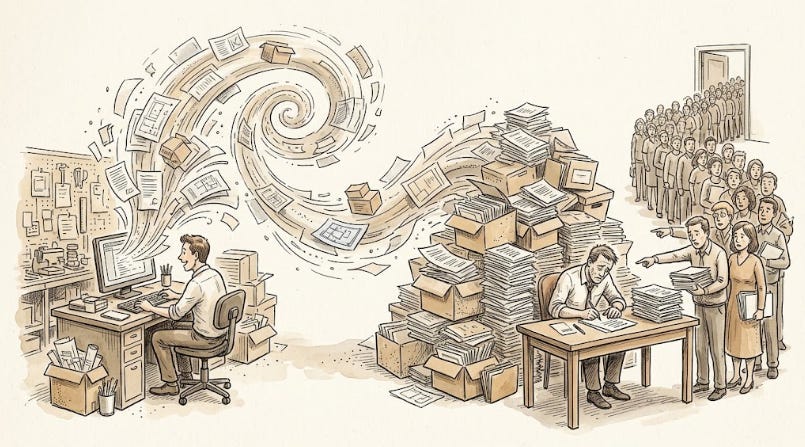
An old manufacturing rule says that speeding up anything except the bottleneck just builds inventory. Agents build code inventory. It piles up in review, in security checks, in sign-off.
Feeling fast and being fast are different things. Just because you - as an individual - believe you are faster with AI doesn’t mean you - and the system you are in - are really faster. We’ve seen this movie before: computers took until the late 1990s to show up in productivity numbers, after companies rebuilt how work flowed around them.
It seems like we will see the same thing happen again just vastly compressed in time. Only when work changes will we see real productivity gains in bigger companies. Complexity slows things down tremendously.
True, some companies will reap big benefits. But in general, if every rival ships faster, margins stay flat. Speed is a necessity to stay even.
Cheap to make, full price to own
A vague idea used to die in the effort of writing it down. Typing code forced you to think clearly and decide what matters. Not everything should be vibe coded. Most things shouldn’t even be built.
Now the idea ships, runs, and does something slightly different from what you meant. As a result many companies will find out that shipping a poor product is expensive. It was before but now it will happen at scale. Code is cheap but the consequences arrive at full price. Each new system creates something to review, secure, maintain and explain, and more software means more things that need someone awake at 2am.
Who picks up the phone
Take the management tool we built for OMClub. It was worth every hour. Now say it emails the wrong ticket codes to 200 guests the night before the event.
The agent that wrote it won’t pick up the phone. I will.
That’s the part cheap code doesn’t change. Someone has to say “yes, ship it” and answer for what happens next. Billing, production access, security, legal: every one of them needs a person like that.
I think the longest queue in most companies now stands in front of that person.
Agents will probably get much better at checking their own work (I expect they will). I don’t think that settles it. A company still needs a person who decides what the system may do, and who takes the call when it does something else.
There’s a catch. The people who can say yes learned by doing: writing code, breaking it, fixing it. If agents take over the doing, where do the next reviewers come from? I don’t have an answer. Would be great to have one before any company stops training juniors.
So the job changes. Understanding software may come to mean setting boundaries, testing behavior and owning the outcome, with something else handling the typing. Whether that adds up to more engineers, fewer, or a different mix, I don’t know.
My main takeaway: white collar jobs will probably survive. They’ll get much harder, and mentally exhausting (but that’s for another post).
Find your longest queue
So what is the main takeaway? Bottlenecks are moving. You find them by looking at where finished work sits and waits in your company. It’s probably in front of one person’s yes.
Make that yes faster and safer. Three things help: tests that catch the obvious, clear limits on what an agent may touch, and a way to undo a change in minutes.
Then ask who answers if it fails. If the answer is “we’ll figure that out later,” later may arrive as an outage (probably at 2am).
The code can now be generated at scale. Responsibility still needs an owner.
🙏
Be kind,
Manuel