


I watched the Tesla Roadster reveal with my kids. They loved it. Hard not to.
A car drove up a curved ramp, hung upside down, then flipped through the air. I’ve never seen a product presentation like it.
I’ve been thinking about it for the last days.
What they actually showed
There are 4 versions (Base, Performance, Thrust and Rocket). The Performance car has the “fan,” which sucks it onto the track. It’s not the first car to do that, but it “feels” like Tesla invented it. That’s a real talent, by the way.
The flying version is Rocket. It’s invite-only, and Tesla’s own website says it’s not approved for public roads. The demo car drove itself with nobody inside. Musk called it “not necessarily a safety-optimized car.”
Even the Thrust version, one step down, puts a 10,000 PSI tank right behind the driver’s head. The thrust lasts 3 to 5 seconds.
So who’s the customer for Rocket? Probably someone who wants a very rare machine, or a closed track. That’s fine. It’s a tiny audience for a very big promise.
And yet the whole thing smells like a deflection. We’ll spend the next weeks talking about the Roadster doing a kickflip. A real engineering feat, sure. Not very useful nor practical in real life.
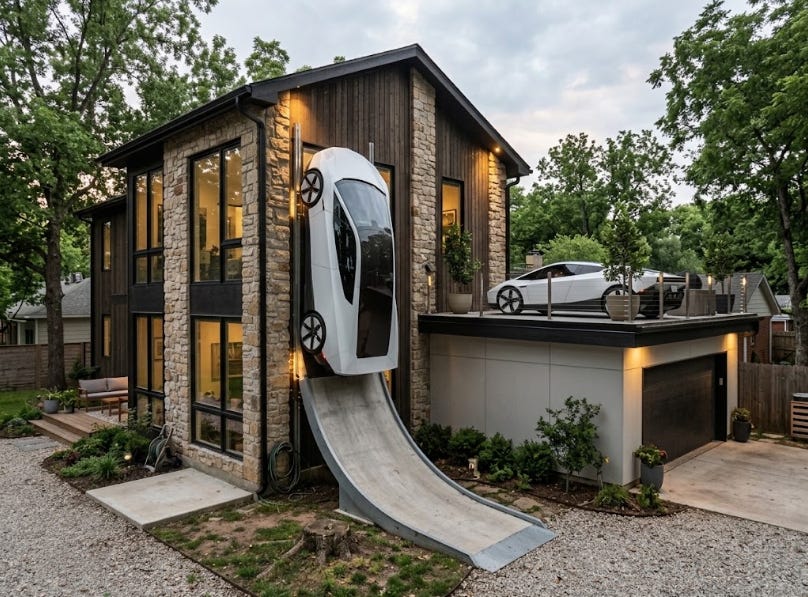
The picture I’m sharing is my own exaggeration: the car parked vertically on your house. It’s a joke, but the reveal was so over the top that it felt about right.
A date is a promise too
There’s a serious point under the joke, though.
Tesla took $50,000 deposits in 2017 and promised deliveries in 2020. The car looked very different back then (I liked the old version better). The target is now 2028.
Think about what a deposit is. Someone hands you real money for something that doesn’t exist yet. They’re betting on your word.
That’s worth more than the cash. The cash gets spent. The trust either holds or erodes. The reservation agreement even says Tesla can’t guarantee when your car arrives, or if it does.
Headlines are cheap
I think the reason is simple: the Roadster will sell in tiny numbers, so it barely matters to Tesla’s business. Tesla is also ending the Model S and Model X. Officially, to free up factory space for Optimus. Both point the same way: less attention on cars people drive every day, more on the next big story. A flying car gets headlines, and even if it never ships, the headlines are the product.
It has company. Owners were sold on robotaxi income that hasn’t happened. Solar Roof tiles stopped selling in August. The Cybertruck was pitched as nearly indestructible, then came repeated recalls and sales far below what Musk talked about.
Any one of these is forgivable. Companies miss dates. Hard things take longer than anyone thinks.
Trust wears down on the pile-up. One disappointment stacked on the last, with no accounting in between.
Then you ask what happened to the previous promise and get called a hater, or told you have “Elon derangement syndrome.”
That’s a strange answer to a fair question.
The boring part is the whole job
Most of running a business is unglamorous. You ship the small version that works. You say “we’re late” early, before the customer has to ask. You fix the thing that broke last month before you announce the thing for next year.
Fixing last month’s bug doesn’t get a livestream. It’s also why customers come back.
Reliability is a product feature, and an underrated one, because it’s boring. A customer feels it when you do what you said, on the day you said it, a hundred times in a row.
Trust works like an account. Every kept promise is a deposit, every dropped one a withdrawal. A big reveal spends from it. Spectacle can run on credit for a while, but not forever.
What useful looks like
I get why people got excited about Tesla in the first place. The path was practical, useful and promising: charge at home, build more chargers, bring the price down. Millions of ordinary people could use the result. Tesla deserves real credit for that.
You could trace a line from the idea to the customer’s driveway. Each step was dull and measurable.
I can’t trace that line from a flying Roadster to anyone’s life. Maybe I’m missing something. To me, the point of the thing is the show.
Three questions for reliable businesses
These work for any big announcement:
Who’s the customer? Name a real person who benefits.
What happened to the last promise? If no one can answer, the next one is worth less.
What’s the path from demo to product? A demo proves it can happen once. A product happens every time.
None of these are hostile. They’re what you’d ask a friend who told you about a big plan over coffee.
Both things can be true
My kids saw something amazing, and they were right. I still love technology and big ideas. I’m tired of watching practical ones get swapped for spectacle, then being asked to applaud the next promise before anyone accounts for the last.
I watched as an entrepreneur too, and I was left with a stale taste: another huge promise, another date, and still no Roadster in a customer’s hands.
The world needs big ideas. It also needs useful products, honest expectations, and someone answering for what was promised. Especially from role models.
That’s what made Tesla exciting to begin with. It’s much less now, at least for me.
You may call me old fashioned. Some things shouldn’t change.
🙏
Be kind,
Manuel