


One of our PIRATE companies recently switched project management tools. A year ago that meant paying someone, accepting data loss, or just staying put because moving hurt too much. We vibe coded the migration - wrote a script, ran it, everything moved over. A few hours, not weeks.
That small moment points at something bigger. But it also has limits worth understanding.
For 20 years the default playbook for building a defensible software company was simple: get so deep into a customer’s workflow that leaving becomes too painful. Customers stay not because they love you, but because moving is a nightmare.
That’s changing - but not uniformly. There are two layers to switching costs and AI is eating them at very different speeds.
The first layer is the code itself. Building a replacement used to require a team, a budget, and months. Now it can take a weekend. That layer is genuinely exposed. If your moat is “we’re complex and nobody wants to rebuild us,” that moat is draining.
The second layer is data gravity. Your customer records, five years of integrations, a team trained on your workflows, compliance history baked into your processes. Nobody vibe codes their way out of that over a weekend. AI lowers the cost of building a replacement. It doesn’t yet lower the cost of the migration. That distinction matters enormously for how fast this actually plays out.
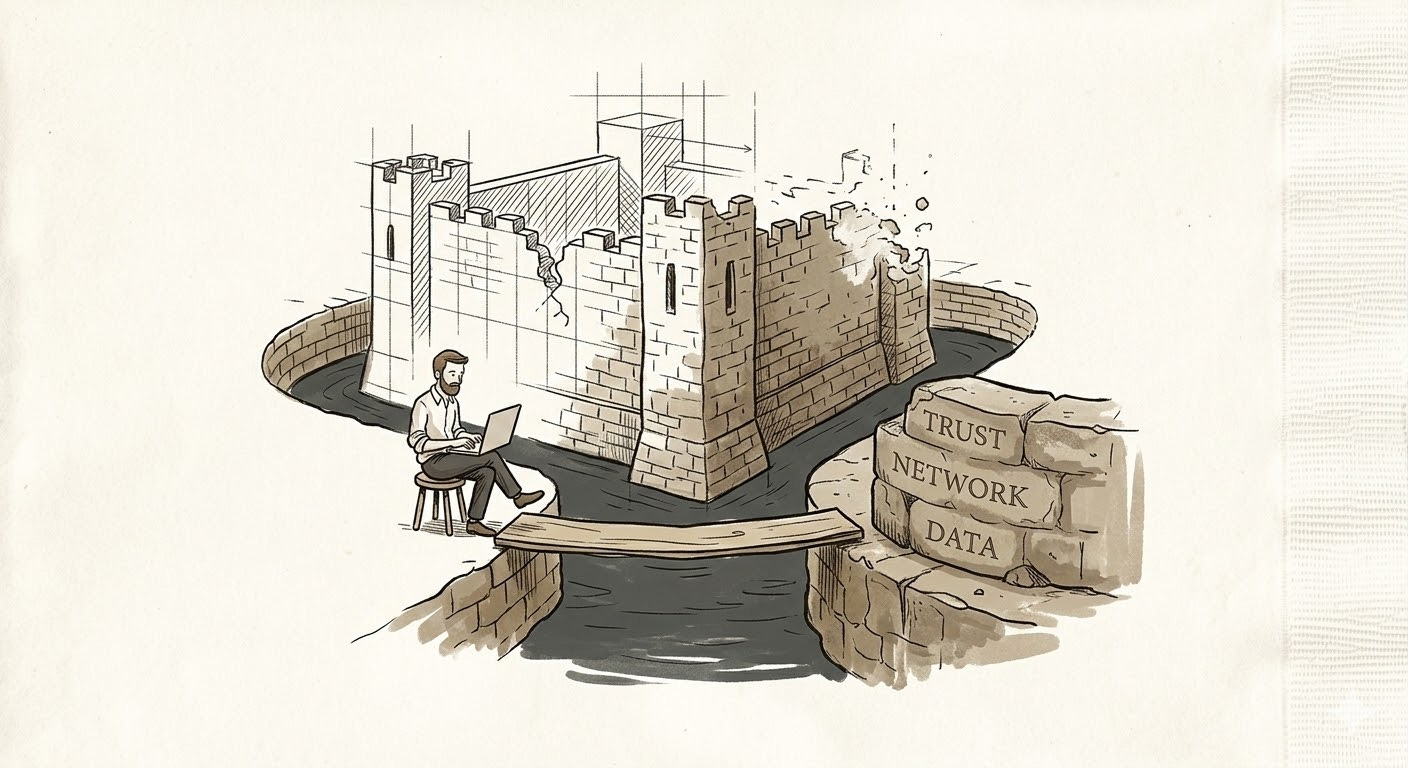
So “all moats are dead” is the wrong conclusion. Defensibility is concentrating - into fewer, harder-to-copy places.
Brand is probably the clearest example of what gets stronger. Think about how you’ll shop when AI agents do most of the buying. You won’t say “find me the best sneaker.” You’ll say “get me Adidas.” The brand decision happens before the agent enters the picture. Software works the same way. If I already trust a company with my data and believe they’ll be around in three years, I don’t need an agent to benchmark them. That trust is the moat. And the more AI lowers every other barrier, the more pre-existing trust is worth.
Brand can’t be vibe coded.
Same with real network density. A competitor can use AI to fake being on a platform - but can’t fake 10,000 drivers already on the road. And truly exclusive data, the kind built through years of direct customer relationships, gets more valuable as models improve. Not all data is equal. “Hard to access” and “truly exclusive” are two very different things, and that gap just got more expensive to ignore.
The moat most software founders spent the last decade building - deep workflow integration, painful switching, stickiness through friction - is getting cheaper to escape at the code layer. The data layer buys time. But time is not a strategy.
What holds is the stuff that takes years and can’t be rushed: real network density, truly exclusive data, brand trust earned through consistency.
If you’re building something new, the honest question is which camp you’re in. Are you building structural defensibility - or planning to win on speed, staying ahead because you move faster than anyone can copy you?
Both are real strategies. But they’re different companies, built differently, with very different ceilings. The time to know which one you’re building is before you need the answer.
🙏
Be kind,
Manuel